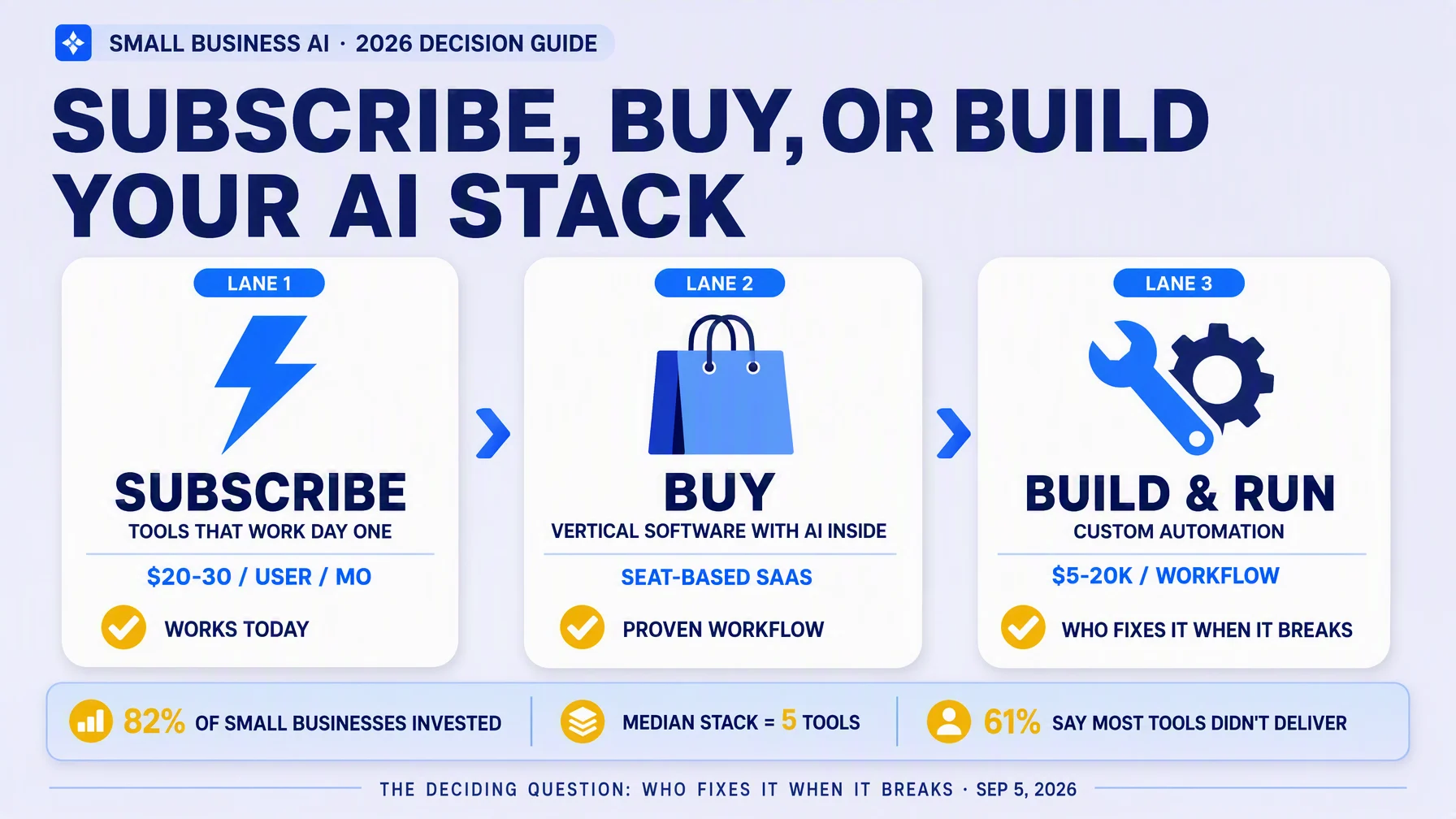
There are exactly three ways a small business can use AI in 2026: subscribe to tools that work out of the box, buy vertical software that already has AI baked in, or build and run custom automation for a process you cannot buy off the shelf. Most small businesses should start in the first lane, move to the second when a proven vendor exists, and stay out of the third until they can answer one question: who fixes it when it breaks? This guide walks the three lanes with real price shapes, what each one actually buys you, and a framework for deciding where your company belongs — without pretending there is a single right answer.
Why 2026 is different: adoption happened, trust didn't
Small-business AI adoption is no longer experimental. The Small Business & Entrepreneurship Council's 2026 survey of small-business employers found 82% have invested in AI tools, with a median of five tools in their stack. A separate UK-wide survey found 38% of SMEs use at least one AI tool regularly, saving an estimated two hours per employee per week on writing and summarization alone. And Thryv's 2026 numbers put the payoff at roughly $500 to $2,000 a month in saved operational costs for small businesses using AI.
The trust side is the other half of the story. In Stack Overflow's 2025 developer survey, 84% of developers said they use AI tools — up from 76% a year earlier — while the share who distrust the accuracy of that output rose from 31% to 46%. Only 3% say they trust it highly. And nearly two-thirds of the small businesses that invested in AI in 2025 told surveyors the tools didn't deliver the value they expected.
That gap matters because it changes what you should buy. Cheap AI is everywhere; trustworthy AI is work. The lanes below are ordered accordingly.
Lane 1 — Subscribe: tools you can use this week
The subscription lane is where most of a small business's AI wins happen, and it costs between $20 and $30 per user per month. It divides into two layers.
The reasoning layer — a general assistant you can chat with and give documents to: ChatGPT Plus, Claude, Gemini, or Microsoft Copilot if you live inside Microsoft 365. All roughly the same price, all good, and all interchangeable for everyday work. Pick by what you already pay for: the assistant that plugs into your existing inbox, docs, and calendar beats the assistant with the slightly better benchmark. You can also run the same models more cheaply than most people realize — see our guide to choosing between Claude models for the price ladder at the top end, or the Gemini 3.8 Flash setup for the per-milli-cent lane.
The reading layer — the unglamorous work of actually consuming information: a contract 80 pages long, a vendor's 40-minute demo video, a prospect's long email thread, your competitor's support doc, last month's sales call. This is where Glarity lives: summarize, translate, and ask questions over pages, PDFs, and YouTube videos in the browser, then export the notes. Most small-business AI regret comes from subscribing to tools nobody opens; the reading layer is the one that gets used daily, because the input — something you needed to read anyway — is already in front of you. Translate on top of that, and one second tool covers your bilingual clients and your staff's recap of a foreign market video.
Two rules for this lane. First, one tool at a time: pick your biggest time sink, run it for 30 days, measure, then add the next. Second, don't put customer lists, financials, or contracts into free consumer tiers — for sensitive data, pay for the business plan that disables data retention; it's still under $30 a month.
Lane 2 — Buy: vertical software with AI already inside
If a vendor already built your workflow, buying beats building. HubSpot's AI features for sales and marketing, Salesforce's Agentforce for customer service, Expensify for receipts, Tidio for simple web support — the pattern is the same across industries: a proven one-ticket workflow (CRM, CRM-ish, expense, support) plus an AI layer that drafts, classifies, or resolves.
Three checks before you buy in this lane:
- Price shape: per seat and per month is predictable. Per-resolution, per-credit, or per-token pricing from a vertical SaaS is a tax on doing more work — a small business should never have to forecast its software bill against its willingness to use it.
- Does it actually replace the manual step? If the "AI" is a text generator bolted onto a tool you were already paying for, it doesn't remove the five-minute manual step. Ask which specific task is no longer done by a human.
- Wrappers are everywhere. Many AI-labeled products at £30–£60 a month are reskinned versions of a general assistant at ten times the price. Test the wrapper against the plain assistant first; if the plain one does the job, you've already bought it.
Lane 3 — Build and run: DIY, or a team as a service
This is the only lane where the question "who fixes it when it breaks?" genuinely decides everything. Two ways in.
DIY. Zapier, Make, and n8n cover most common workflows; Zapier starts free and costs roughly $20 a month at the level where you stop fighting limits, Make is cheaper per operation with a steeper learning curve, and self-hosted n8n is the favorite of anyone technical. The ceiling is the same for all three: you are the operations department. When a workflow silently stops working at 7pm, the person who fixes it is whoever built it. DIY is right when the process is small, stable, and you have someone accountable.
A team as a service. A 2026 crop of agencies explicitly sells the running, not just the build — the pitch being that most agencies build a tool and hand it over, leaving the client to discover the monitoring and the failures alone. The specifics worth asking for are concrete: a locked written spec before any code, a human approving the plan and a human reviewing the code (never a model grading itself), nothing automated until it has run by hand, a 10-day ramp for an embedded engineer, and one monthly retainer covering build, hosting, and operations rather than per-token billing. Maxpertise is one example of this model, running on exactly those terms — two human gates, manual-first automation, and signed-to-embedded in about ten days — and the Maxpertise page is worth reading before you evaluate anyone in this category. It publishes no client performance numbers, and its "What Maxpertise is not" section states the boundaries up front — an agency that writes down what it will not do has done half your diligence for you.
No matter which way you build, the contract matters more than the tech: you own the code and the data, there is a time-boxed proof window before your commitments, and a clean exit with no handover fee.
The decision framework
Your situation | Lane | Why |
|---|---|---|
A repeat task that takes you one hour a week | 1 — Subscribe | A subscription costs less than the setup (and a few minutes to adopt) |
You're adding AI to a tool you already pay for | 2 — Buy | The vendor already owns the workflow; don't rebuild it |
The process is the business, and it runs 20+ hours a week | 3 — DIY first, then team-as-a-service | The savings justify a build; the running is the real cost |
Nobody on the team is technical, or the FTE is needed for revenue | 1 — or 3 Managed | You can use tools without reading the docs; you shouldn't have to babysit a build |
You found yourself sketching "invoices.json" by hand | 3 — Build | It's already a process; formalize it |
The output touches contracts, money, or medical data | 1 or 2, with a human review step | Custom builds raise the stakes, not lower them |
One rule to steal from the people who build these systems for a living: no workflow is automated until it has been run by hand and someone has watched it work. What is true for a custom build is true for anything you buy.
What small businesses actually automate first
The same short list keeps coming back from providers and marketplaces: lead qualification and data validation (the endless "is this lead real?" garbage-collection step), reporting dashboards (a copy of a data pull nobody wants to do weekly), invoice and payment tracking, appointment and reminder messaging, applicant screening, and support triage. All of these are one underlying shape: a document or a message comes in, gets read, classified, and routed, with an explanation of what it was based on. If half of your week looks like that shape, you are a candidate for the third lane — and a reasonable 2026 budget for a single contained workflow of that kind is roughly $5,000 to $20,000 as a project, with multi-step operations builds running $25,000 to $80,000.
Common mistakes
- Subscribing to everything at once. Five tools you never open cost more than one tool you use daily.
- Skipping the human review. With 46% of developers distrusting AI output and only 3% trusting it highly, that distrust is a fact, not a vibe. The cheapest insurance in small business AI is a named human who reads what ships.
- Free tiers for sensitive data. Free means training data, somewhere.
- Automating a broken process. A workflow that's wrong by hand will be wrong faster by machine.
- No audit trail. Save the prompt, the output, and the edit. In a dispute with a vendor, an employee, or a customer, that trail is the difference between an answer and a maybe.
- Buying the wrapper. If the vendor cannot say exactly what the model does in the product, it's a rebrand.
- Treating AI as a body count. The winning framing in small business is AI as a force multiplier. The relationships, the judgment, and the culture remain yours.
FAQ
What does a realistic AI stack cost? For tools: roughly $40–$55 a month for a solopreneur, $80–$150 for a team of three to five, and $400–$700 a month for a growth-stage SMB — using five to seven tools well beats fifteen tools badly. For custom work: $5,000–$20,000 for a single contained workflow, $25,000–$80,000 for multi-step operations.
Do I need a technical person to use AI? For lane 1 and 2, no. For lane 3, the honest answer is: you need someone. "Technically responsible" can be an engineer on your bench, or an agency running it for you with human review — but never a gap between "the project shipped" and "nothing monitors it."
Why do agencies bill monthly instead of per token? The retainer model means the vendor has an incentive to make the system work better, not just produce more usage. Per-token and per-seat billing charge you for using what you already paid them to build, and make your monthly spend a function of someone else's product design.
How do I keep AI from subtly hurting my business? Run the small loop first, keep one human owner per automation, keep the review short and scheduled, and keep an audit trail. That is the whole playbook — it fits in one line.
Where does the "reading AI" fit in all of this? As the front door. Most AI-in-business projects assume you already know what needs to be read and summarized — but the reading itself is usually the time sink, and the gap between costs that sink first. Summarize and translate the material before you decide what to automate; that's the first 80% of the effort for almost none of the cost.
Glarity's editorial team covers AI search, video summarization, and browser productivity tips.
Glarity is a free browser extension for AI search, YouTube video summaries, and page translation — available at glarity.app.