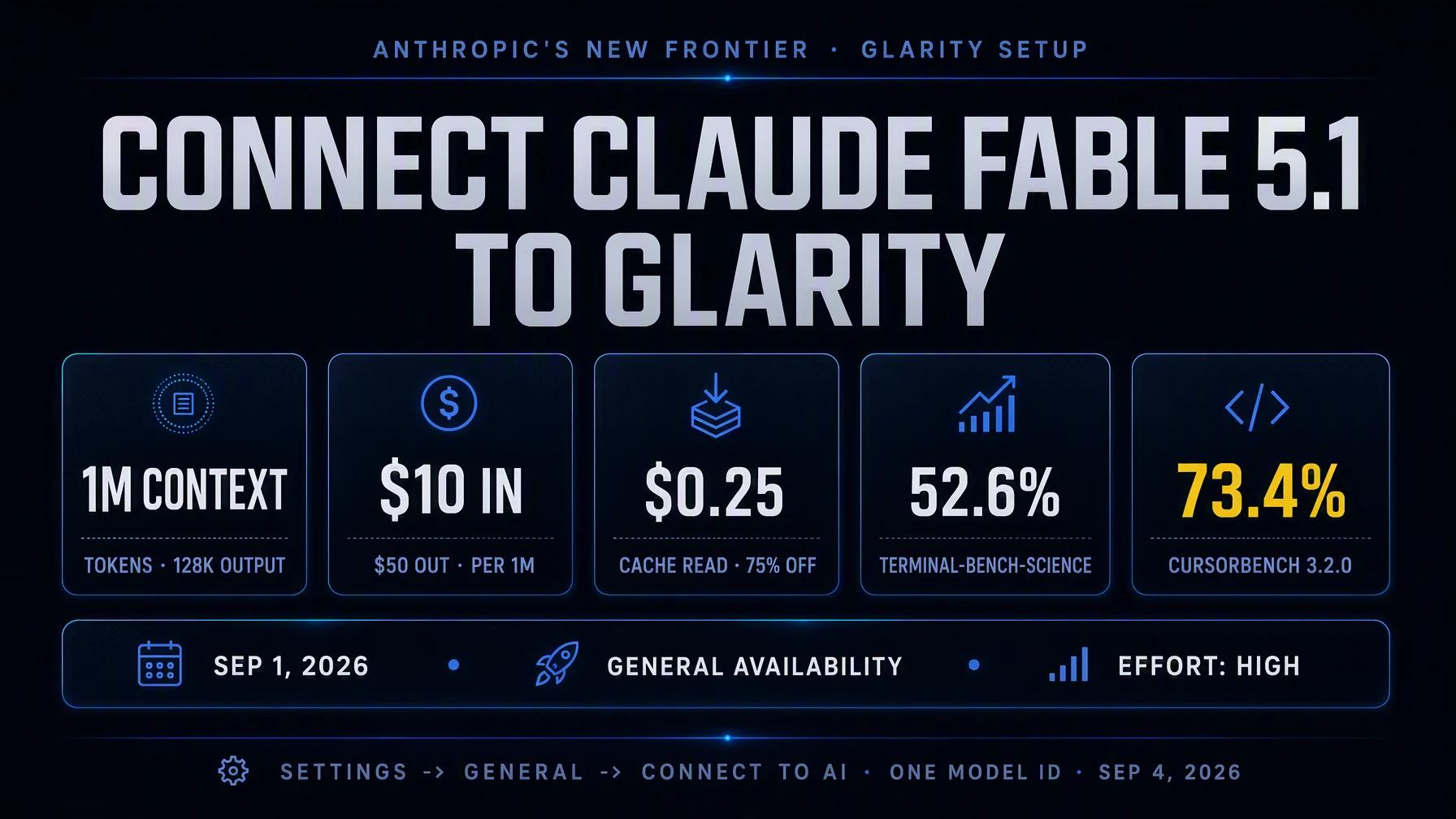
Anthropic released Claude Fable 5.1 and Claude Mythos 5.1 on September 1, 2026. Fable 5.1 is the one that is generally available — Anthropic calls it its most advanced model for demanding reasoning and long-horizon agentic work, and its docs add an honest rule of thumb: start with Claude Opus 5 for most workloads, and reach for Fable 5.1 "when your evals on Claude Opus 5 at higher effort still fall short." Connecting it to Glarity is four moves: select OpenAI API key (the entry Glarity uses for Anthropic too, via Anthropic's OpenAI-SDK compatibility layer), paste your sk-ant- key, type claude-fable-5-1 into Custom Model, and set the host to https://api.anthropic.com/v1. Two caveats up front: it is priced like a frontier flagship — the same $10 / $50 per million as OpenAI's GPT-6 Astra, which means every session's math matters; and its restricted sibling, Mythos 5.1, is invitation-only and is not what you connect here.
Claude Fable 5.1: a quick spec sheet
Field | Value |
|---|---|
Model ID |
|
Context window | 1M tokens — roughly 555,000 words on the current tokenizer |
Max output | 128K tokens |
Knowledge cutoff | June 2026 |
Input → output | Text and images → text |
Thinking | Adaptive, always on — steered by effort; default |
Pricing | $10 / 1M input, $50 / 1M output; cache writes $12.50; cache reads $0.25 / 1M (down from $1) |
Availability | General availability on the Claude API and major cloud platforms |
The details come from Anthropic's model page and its announcement. The announcement adds the numbers that frame the decision. On Anthropic's announced evaluations, Fable 5.1 scores 52.6% on Terminal-Bench-Science (Fable 5: 24.7%, Opus 5: 29.0%), 73.4% on CursorBench 3.2.0, and 65.0% on Humanity's Last Exam with tools — internal numbers, not third-party verdicts, but they describe what Glarity actually does: hold a whole document, reason across it, and produce something worth reading. Pricing-wise, Anthropic says Fable 5.1 costs about 25% less than Fable 5 for typical workloads (up to ~45% less for highly agentic work), measured over four weeks of August 2026 usage at default effort — with cache reads cut by 75% to $0.25 per million.
Why this model fits Glarity
Glarity's daily jobs are reading jobs: summarize a page, translate a page, turn a one-hour YouTube video into notes, answer questions about a document. Fable 5.1's 1M-token window swallows a 300-page book in one request, and its always-on adaptive thinking at default high effort is exactly what a long research report or a semester's lecture transcripts need — the model sees the beginning and the end at the same time, instead of stitching together section notes. Image input is a bonus: paste a chart or a page from a scanned book and ask about it in the same conversation.
The catch is the price: this is the most expensive Claude tier, twice Claude Opus 5's $5 / $25. So the rest of this article answers two questions honestly — what does each session actually cost, and what should you keep on a cheaper lane.
First, check your access
The access story here is the opposite of a staged rollout: Fable 5.1 is generally available today. If you have an Anthropic API key, you have access — no waitlist, no admin toggle, no approve-window. Where the checkpoint sits is that this launch has two models, and only one of them is yours:
- Claude Fable 5.1 — general availability, all platforms. This is the model you connect in Glarity.
- Claude Mythos 5.1 — same specifications and pricing, but restricted to Anthropic's Project Glasswing programs (cyber and life sciences verification), currently for participating organizations, and it now also powers Claude Security. Its access is via an account team; a normal API key will not reach it.
So the only "access" check worth doing: run Test with the empty setup. Two different errors mean two different things. 401 means the key needs attention (see the failure table). "Model not found" almost always means the ID was mistyped — claude-fable-5-1, not a dated variant and not the Mythos name. Anthropic's API is also region-gated, so confirm your region on the supported regions page if Test never goes through.
Connect it in four steps
Open Glarity, go to Settings → General, scroll to Connect to AI for quick Glarity summaries and translations, and:
- Select "OpenAI API key" — this entry works for Anthropic, because Anthropic publishes an OpenAI SDK compatibility layer that accepts OpenAI-format requests.
- Paste your Anthropic API key into the API Key field. Keys start with
sk-ant-and come from the Claude Console. An OpenAI key will not work here. - Model — choose Custom Model and type
claude-fable-5-1exactly. If the dropdown already lists Claude Fable 5.1, just pick it. - Set Temperature to 0.5 (drop to 0.2 if you want literal, word-level translation), press Test, then Save.
Two fields stay at their documented defaults, but check them once. API Host: https://api.anthropic.com/v1 — the exact base URL from Anthropic's own compatibility quick starts; API Path: /chat/completions. If a previous setup left another provider's host here, change it back — that is also the fix when Test returns a connection error instead of a model error. Model Context Window: pick the largest preset; the 1M model ceiling is the real limit, and the preset is only a safety ceiling.
One thing you don't configure: thinking depth. Fable 5.1's adaptive thinking is always on, running at default high effort. Glarity doesn't expose reasoning parameters, and it doesn't need to — the effort you'd want for frontier reading work is already the default.
What a session really costs
At $10 per million input tokens, Fable 5.1 is priced exactly where GPT-6 Astra sits — and like that model, a single request is cheap until it isn't. Here's the math for the sessions Glarity users actually run — round estimates, actual token counts vary by language and page complexity:
What you feed it | Tokens in | Tokens out | Approx. cost |
|---|---|---|---|
1-hour YouTube video → summary | ~12,000 | ~800 | ~$0.16 |
30-page report → summary + chat | ~40,000 | ~1,500 | ~$0.48 |
300-page book → whole-book summary | ~230,000 | ~3,000 | ~$2.45 |
Big research stack (roughly 500K input) | ~500,000 | ~8,000 | ~$5.40 |
Same stack under GPT-6 Astra's long-input premium | ~500,000 | ~8,000 | ~$10.60 |
The last two rows are the meaningful difference between the two flagships. Anthropic prices its full 1M context at standard rates, so a 500K-token request has no long-context premium — whereas GPT-6 Astra multiplies input and cache rates by 2x above its 272K threshold. Feeding the same stack to both models would cost roughly twice as much through OpenAI's route.
The one caveat Glarity users should know: the compatibility route does not support prompt caching — that is stated in Anthropic's own compatibility-layer docs. The headline $0.25 cache-read price (75% below Fable 5's $1) applies to apps using the native API. Through Glarity, every turn re-bills its full input, so a multi-turn conversation about a 230K-token book costs the first pass and every follow-up. Do the reading in one well-formed request; that is where the $2.45 stops being a single-serving number. In return, the model's own accounting says Fable 5.1 runs about 25% cheaper than its predecessor for the same kind of work — the 75% cache cut and the agentic efficiency gains are a large part of where that comes from.
When to use it — and when to skip
Use Fable 5.1 in Glarity when the answer is worth the click: whole-book summaries, research-paper stacks, hour-plus lectures, nuance-critical translation and proofreading of professional text, and drafting an email that takes a position on what you just read. It is also the Glarity session slot that has no long-context premium, so the large-but-finite read — 500K-class research dumps — is its natural home.
Skip it for the daily grind, and skip it by default if your sessions are quick. Anthropic's own guidance says start with Opus 5 for most workloads; Glarity's equivalent advice is start with the cheap lanes. Two correct moves: if you want Claude specifically but not the frontier price, our Claude Sonnet 5 setup guide is the $2 / $10 lane — five times cheaper per token, same vendor, one-field switch between them. If you want the true per-milli-cent lane, the Gemini 3.8 Flash guide is the one to save. And if you're happy with OpenAI, read our GPT-6 Astra guide before switching: at the same price tier, the two differ mainly in the >272K premium and in caching behavior — not in the format of your summaries. A good rule: Fable 5.1 is for the reading you'd otherwise print and the work you'd otherwise hand to two models; a Flash- or Sonnet-class model is for the reading you scroll.
If something fails
Symptom | Likely cause | Fix |
|---|---|---|
Test returns 401 | Wrong key, or an OpenAI key in the field | Create a key in the Claude Console (starts |
"Model not found" | Typed ID isn't the exact model | Type |
529 or "Overloaded" | Anthropic's own overloaded error | Wait a moment and retry — the compatibility layer passes Anthropic's status codes through |
Connection error on Test | Wrong host from an earlier setup | Set API Host to |
429 or rate limit | Usage-tier RPM/TPM limits on your key | Wait; request a limit increase in the Console |
Long request rejected | Over the 1M-token window | Split the document; 1M tokens is roughly 555,000 words on the current tokenizer |
FAQ
Is Claude Fable 5.1 free? No ongoing free tier — every call bills per token. Anthropic's pricing FAQ notes that new accounts receive a small amount of free credits to test the API, which covers a handful of sessions at most; budget for what you actually read.
Why doesn't Claude Fable 5.1 show up in the model dropdown? The dropdown can lag new releases. Custom Model + claude-fable-5-1 is the correct path, and it still uses Anthropic's official endpoint. The dropdown is a convenience; the ID is the contract.
Does this replace my GPT-6 Astra or other setup? No — Glarity's "Connect to AI" runs one configuration at a time. Switching between Anthropic models (Fable 5.1 ↔ Sonnet 5) is a one-field change; switching providers means updating the model field, the API key, and the host, so keep both credentials handy.
Is this better than Claude Sonnet 5 for summaries? For short summaries, you will not notice a difference that justifies 5x the price. The gap shows up on long documents and multi-hour transcripts, and in reading-accuracy on dense material. Anthropic's own guidance is to start with Opus 5 and move up only when evals fall short — Glarity's version of that: start with Sonnet 5, and move to Fable 5.1 when the output is not good enough and you know the reason.
Would Fable 5.1 change how Glarity translates? The pipeline stays the same; the model changes how well it holds a long document in both languages across the whole text. For strict, literal, sentence-by-sentence translation, keep the temperature at 0.2.
Glarity's editorial team covers AI search, video summarization, and browser productivity tips.
Glarity is a free browser extension for AI search, YouTube video summaries, and page translation — available at glarity.app.