Gemini 3.8 Flash Cyber is Google's cybersecurity-specialized variant of Gemini 3.8 Flash, announced September 2, 2026. It's built for defensive security work — finding, explaining, and helping patch vulnerabilities — and Google reports strong internal results on vulnerability-discovery benchmarks. It is not, however, something you can drop into Glarity's Custom Model setting the way you can with a general-purpose chat model. Here's why, and what that means if you were hoping to use it for everyday browsing tasks.
What makes it different
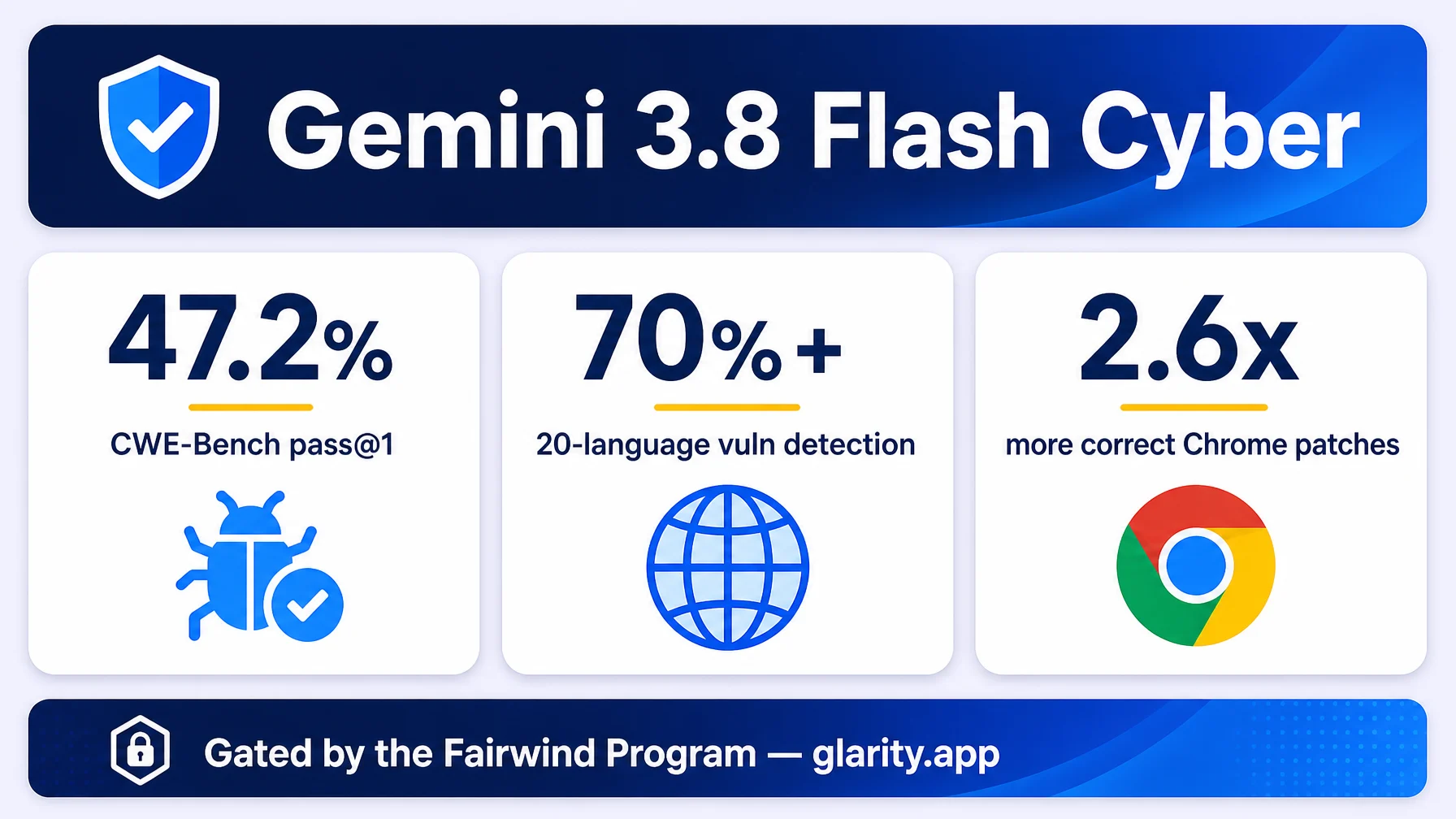
Regular Gemini 3.8 Flash is a general-purpose model available through the standard Gemini API, priced at $0.75 per 1M input tokens and $3.75 per 1M output tokens (through the end of 2026, per Google's published rates). Flash Cyber is a separate deployment built around the same base model but paired with Google's CodeMender system inside controlled cloud environments, running more permissive cybersecurity mitigations than the public model needs. Google reports it scores over 70% on an internal multi-language vulnerability-detection benchmark and 47.2% pass@1 on CWE-Bench — figures that describe this restricted deployment, not the public Flash model, and that come from Google's own testing rather than independent verification.
Why you can't connect it to Glarity
Glarity's Settings → General → Connect to AI panel accepts any vendor exposing an OpenAI-compatible /chat/completions endpoint with a standard API key — that's how guides for models like Grok or Gemini 3.8 Flash work. Flash Cyber doesn't fit that shape for two reasons:
- No public API key exists. Access runs through Google's Fairwind Program, limited to governments, critical-infrastructure operators, software maintainers, and vetted security partners — not general developers or consumers.
- No published model ID, context window, or pricing. Google hasn't released an API surface for Flash Cyber the way it has for the standard Flash model, because it isn't meant to be called as a standalone chat assistant. It's deployed as part of a controlled discover-patch-validate workflow within an organization's own cloud environment.
Even if you had Fairwind access, there's nothing to type into Glarity's Model or API Host fields — the restricted deployment isn't exposed as a generic chat endpoint.
What to use in Glarity instead
If you want a fast, low-cost Google model for Glarity's translation and summarization features, the generally available Gemini 3.8 Flash is the one to connect — see Glarity's existing guide for that setup. If your interest in Flash Cyber is specifically about security research, that's a workflow for your organization's security team to pursue directly with Google, not something to route through a browser extension.
FAQ
Is Gemini 3.8 Flash Cyber available to the public? No. It's restricted to the Fairwind Program — governments, critical-infrastructure operators, software maintainers, and vetted security partners. There's no general public or developer access.
Does it have its own pricing or context window? Google hasn't published either for Flash Cyber. The $0.75/$3.75 per-1M-token rates you'll see cited elsewhere belong to the standard, publicly available Gemini 3.8 Flash, not the Cyber variant.
Can I request Fairwind access to use it in Glarity? Even with Fairwind access, Flash Cyber isn't exposed as a plug-in chat endpoint — it's deployed within a controlled workflow, not as something you'd point a browser extension at.
What should I use for everyday Glarity summarizing instead? The standard Gemini 3.8 Flash, connected through Glarity's Custom Model setting, covers translation, page summaries, and YouTube summaries at a published, affordable rate.
By the Glarity Editorial Team. The Glarity Editorial Team writes about AI search, video summarization, and getting more from your browser.