The old playbook was launch on PH, wait for press, rank on Google. AI summaries flipped the order. Here is what the new funnel looks like and which launch tactics double as AI citation drivers.
The SaaS launch playbook has been stable for a decade. You build an audience before launch, ship on Product Hunt or Hacker News, hope for press pickup, and then spend months earning Google rankings so buyers find you when they search. That order made sense when Google was the only discovery gatekeeper buyers trusted.
That order is now inverted.
Buyers no longer wait for Google. They ask ChatGPT, Perplexity, Gemini, or Felo to recommend a tool for their use case, and the answer arrives as a synthesized paragraph citing three to five sources. The product that gets cited in that paragraph gets the traffic. The product that does not is invisible, regardless of where it ranks on Google.
The old funnel: Build audience, Launch on PH/HN, Hope for press, Rank on Google over 6-12 months, then Buyer discovers.
The new funnel: Launch, Get cited in AI summaries, then Buyer discovers before they ever Google you.
This is not a future trend. The data is already decisive.
What AI Search Has Already Changed
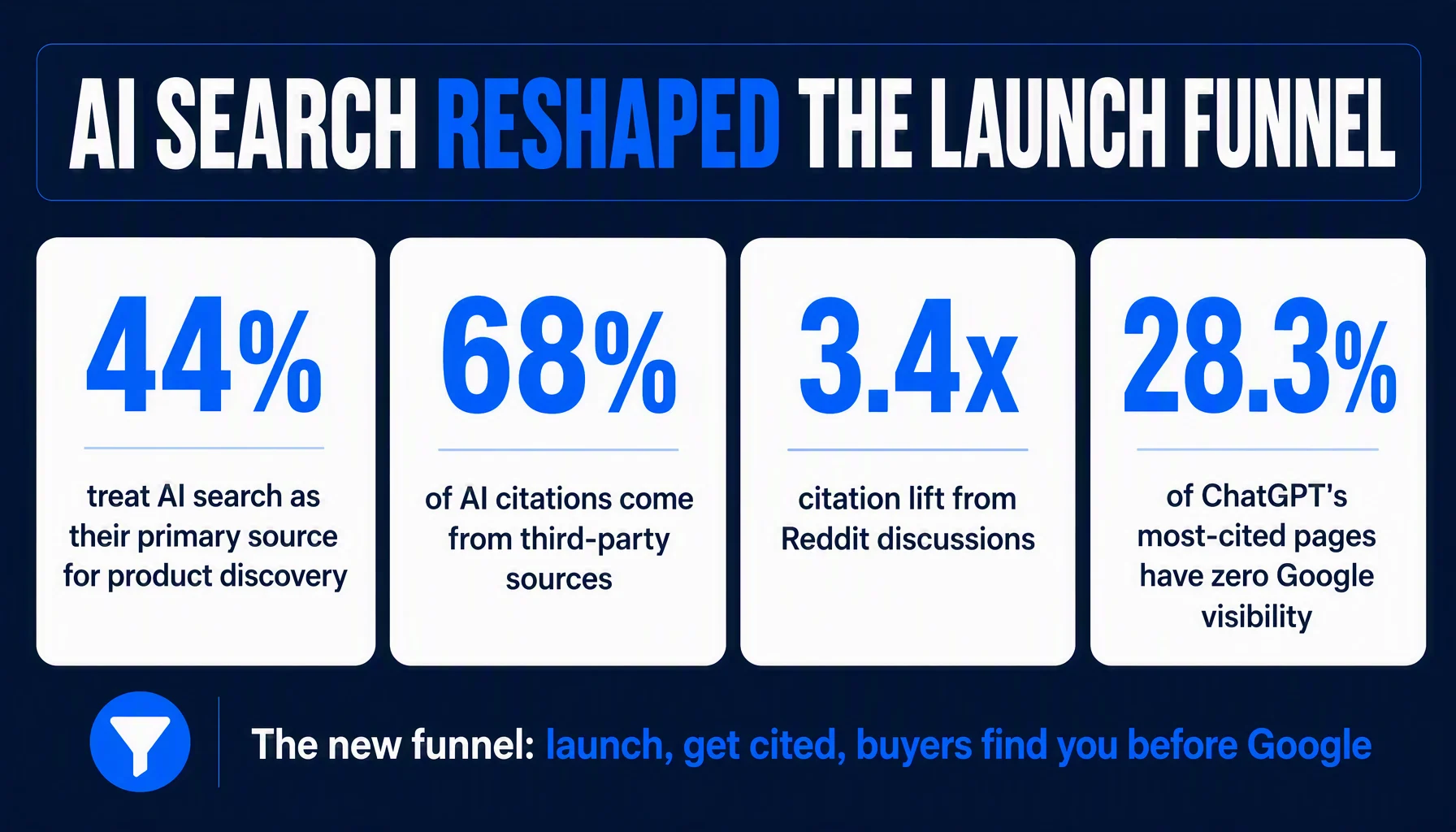
McKinsey's survey of US consumers found that 44% of AI-powered search users now treat it as their primary source for product discovery and buying decisions. Traditional search sits at 31%. Brand websites and review sites trail at 9% and 6% respectively. The new front door to the internet is an AI-generated answer, not a search results page.
This shift has two implications for SaaS founders. First, organic Google traffic is no longer the top-of-funnel priority it was five years ago. Second, the routes that feed AI citations are fundamentally different from the routes that feed Google rankings.
Ahrefs analyzed ChatGPT's 1,000 most-cited pages and found that 28.3% of them have zero Google organic visibility. These pages are invisible to traditional search but cited repeatedly by ChatGPT. They earn traffic through AI answers, not through search rankings.
The gap between AI visibility and SEO is not small. It is structural.
Why Third-Party Sources Dominate AI Citations
The most common mistake SaaS founders make is believing their own website is the best place to get cited. It is not. Erlin's analysis of 500+ brands across major AI platforms found that 68% of AI citations come from third-party sources. Only 32% come from brand-owned content.
AI engines prioritize sources they can triangulate. When the same fact appears across Reddit, Wikipedia, G2, and a major publication, the AI has higher confidence in that fact than it does in the same claim sitting on a brand's own about page. A brand website is the least trusted source for information about that brand.
The data on which third-party sources carry the most weight is clear. Reddit discussions deliver a 3.4x citation lift over owned content alone. Wikipedia delivers 2.9x. Review platforms like G2 and Capterra deliver 2.6x. YouTube delivers 2.1x.
For SaaS launches, this changes the calculation on where to invest time.
Which Launch Activities Drive AI Citations
Not every launch activity contributes equally to AI visibility. Some tactics that mattered under the old funnel (directory listings, press release distribution) have limited citation impact. Others that seemed secondary (deep Reddit participation, structured comparison data) now carry outsized weight.
Product Hunt launches remain valuable, but for different reasons. Product Hunt pages are regularly crawled by AI engines. A PH launch with a well-structured product description, clear pricing, and detailed feature lists creates a third-party data point that AI systems can cite. The value is not the one-day traffic spike. The value is the persistent, structured product profile that AI engines reference for weeks and months afterward. Treat your PH listing as an evergreen citation asset, not a launch event.
Reddit participation is the highest-leverage launch activity for AI visibility. Reddit Q&A threads account for more than half of Reddit's total contribution to AI citations. The format of a genuine question followed by a substantive, specific answer maps directly onto how AI engines generate responses. Participate in relevant subreddits by answering questions about your category, not by promoting your product. The citation lift is 3.4x, but it depends on the thread being authentic and helpful.
Comparison pages and structured data are citation gold. Erlin's research found that comparison tables drive a 34% coverage lift in approximately 14 days. AI systems parse HTML tables almost verbatim. A launch post that includes a table comparing your product's features, pricing, and integrations against alternatives creates an extractable asset that AI engines can cite directly. FAQ sections with FAQPage schema are 3.2x more likely to appear in AI overviews. Nearly 80% of pages cited by ChatGPT use lists or structured Q&A formats.
Review volume on G2 and Capterra matters more than most founders realize. 50 or more reviews on G2 or Capterra place a brand in the AI Preferred coverage tier. Launch strategies that include an early review campaign (real early adopter reviews, not fake ones) create a citation asset that compounds.
Earned media mentions are more valuable than backlinks. Ahrefs found that brand mentions correlate with AI visibility at 0.664, while backlinks correlate at only 0.218. A mention in a credible industry publication carries more AI citation weight than a link from that same publication. Your launch press strategy should prioritize editorial coverage over link building.
What This Means for the SaaS Launch Timeline
Under the old funnel, the critical path was: launch, press, then Google rankings. The time to first buyer could be months.
Under the new funnel, the critical path is: launch, structured third-party presence, then AI citation. The time to first buyer can be measured in days to weeks.
The reason is timing. Erlin's data shows that content under three months old averages 48% AI coverage, while content over 24 months old averages 18%. Freshness carries a measurable premium. A well-executed launch that creates five to seven structured third-party data points (Product Hunt listing, Reddit Q&A thread, G2 reviews, a comparison page, a press mention, a YouTube walkthrough, a Wikipedia entry if eligible) can push a brand into AI citation range within weeks.
That speed was impossible under the old Google-centric funnel.
The Launch Tactic That Does Not Change
One thing from the old playbook still matters: entity consistency.
AI models build an internal picture of your product by aggregating descriptions from many sources. If your PH listing calls it a "marketing automation platform," your Crunchbase profile calls it an "AI analytics tool," and your website says "revenue intelligence software," the AI receives three conflicting signals. Conflicting signals reduce citation confidence.
Use the same language across every surface. One product category. One primary use case. One sentence summary. Consistency is a direct input to how confidently AI engines recommend your product.
The Bottom Line
The SaaS launch funnel is faster, more fragmented, and less dependent on Google than it has ever been. The founders who adapt treat every launch touchpoint as a citation surface. They invest in Reddit and review platforms the way they used to invest in guest posts and link building. They structure their content for extraction, not just for reading. And they monitor what AI says about their product, because the gap between being cited and being invisible is now measured in weeks, not months.
The old launch funnel was a marathon. The new one is a relay: pass the baton from Product Hunt to Reddit to G2 to comparison tables to press coverage, and let AI search carry it the rest of the way.
About the author: Nick runs Nick Launches, a weekly launch platform for indie SaaS products. He tracks how AI search is changing product discovery and writes about what actually works for getting new tools in front of buyers.