Every time an AI model answers a question, a physical chain of hardware sits behind that response: a data center full of servers, a burst of computation called inference, and a real draw on water and electricity somewhere on the grid. Most people who use AI daily never see this layer, but it decides how fast a model responds, what it costs to run, and how much strain it puts on local infrastructure. For readers who want more technical depth than this overview, aitooldiscovery's ai infra guides cover the hardware, data center, and energy side of AI in more detail.
Data Centers
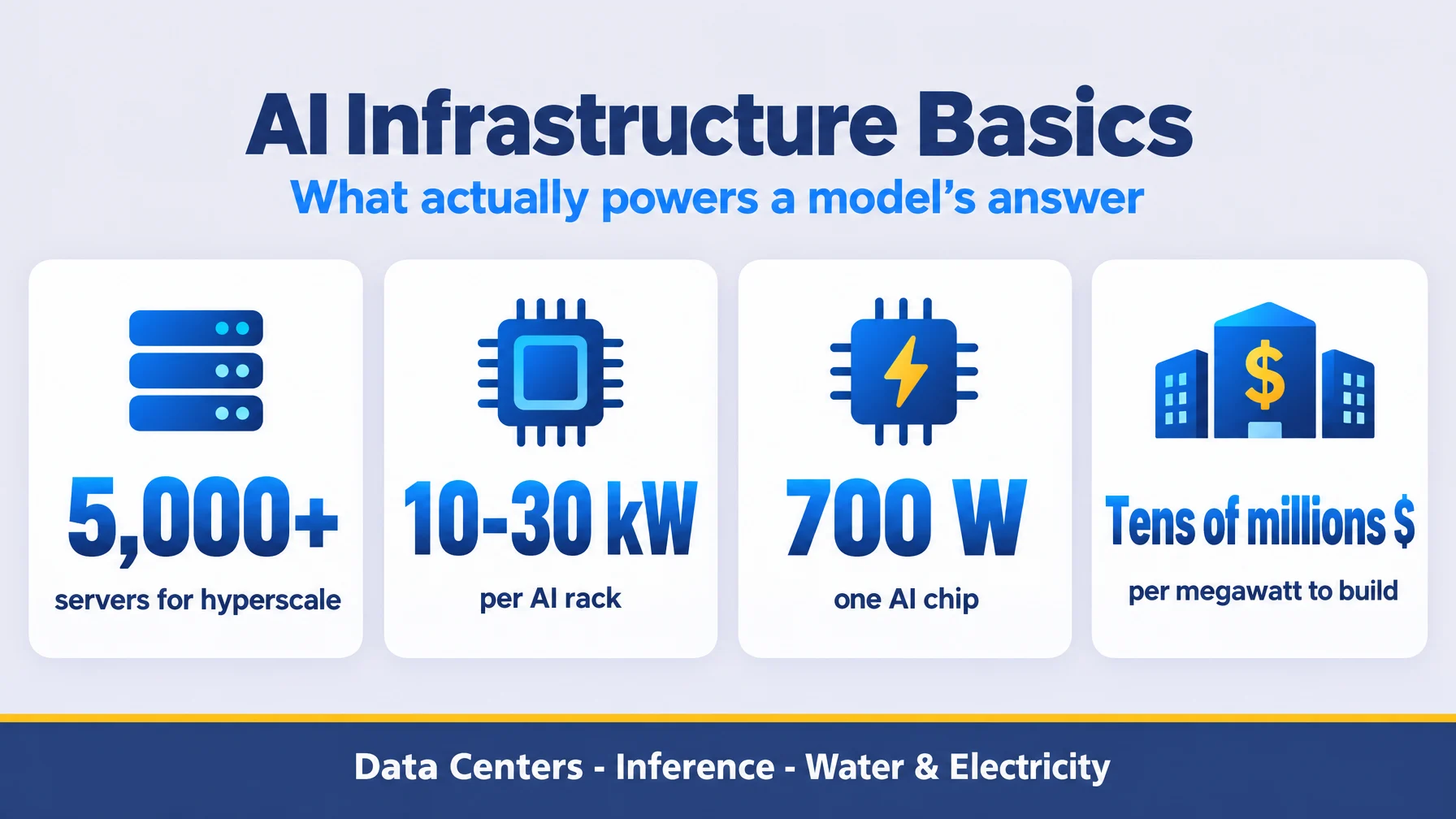
An AI data center is not just a bigger server room. The industry threshold for "hyperscale" is 5,000 or more servers packed into at least 10,000 square feet, and the largest AI campuses now run past a million square feet on a single site. What actually changed with AI is density. A standard web server rack draws 3 to 5 kilowatts. A rack built for AI training, loaded with GPUs, can draw 10 to 30 kilowatts, and a single high-end AI chip alone can pull 700 watts before counting the rest of the server around it.
That density is why AI data centers increasingly need liquid cooling instead of the fans and air handlers that cooled server rooms for two decades. Air can no longer move heat away fast enough once a rack is packed this tight with power-hungry chips. Building one of these facilities from scratch, with the electrical and cooling systems an AI workload actually needs, now runs into the tens of millions of dollars per megawatt, which is part of why the largest cloud providers are collectively committing hundreds of billions of dollars to new AI-ready capacity over the next few years.
Inference Never Stops
Training a model happens once, or occasionally again for an update. Inference is different. It is the computation that runs every single time someone sends a prompt and gets an answer back, and it does not care how impressive the original training run was. Training gets most of the public attention because the number is dramatic and one-time. Inference is the quieter cost that scales directly with how many people actually use the product, and for any AI tool with a real, growing user base, inference compute becomes the larger ongoing expense over the model's life.
Response speed comes from this same layer. The GPUs, the memory bandwidth around them, and how efficiently a data center routes a request all determine whether an answer lands in half a second or several. Most of the infrastructure investment happening right now, in specialized inference chips and in data centers built closer to users, is aimed at making that everyday response faster and cheaper, not at making the next training run bigger.
The Resources Nobody Sees: Water and Electricity
Every AI data center depends on two physical resources, and both scale with how much compute is running. Electricity is the obvious one. AI-optimized facilities can require tens or hundreds of megawatts of continuous power, enough that some new sites are being built next to their own dedicated power generation instead of waiting on grid upgrades.
Water is the less visible one. Many large data centers still cool themselves with evaporative cooling towers, which lose water to evaporation as part of the process, and a single large facility can use an amount of water comparable to a small town on a hot day. Neither of these numbers is fixed. Liquid cooling cuts water loss compared to older evaporative systems, and renewable power contracts are becoming standard for new builds. But the underlying fact does not change: every AI response, no matter how instant it feels, is backed by a real building drawing real power and real water somewhere.
AI infrastructure is not an abstract cloud sitting somewhere far away. It is data centers with hard power and cooling limits, an inference workload that never really stops once a product has real users, and a resource footprint that grows alongside adoption. That is why AI companies now talk about power contracts and cooling systems almost as much as they talk about model quality.