Nick, founder of Nick Launches
Most "best launch platform" roundups assume the reader can text a few hundred people the moment their product goes live and expect a good share of them to click and vote. If you have built an audience, that assumption is fair. If you are one person shipping a side project with no newsletter, no followers and no community that owes you a favor, the same advice quietly sets you up to fail, because the platforms it ranks first reward a network you don't have.
I run Nick Launches, a daily launch directory, so I read a lot of these comparisons and I have a stake in how founders think about the category. That bias is worth naming up front rather than pretending it isn't there.
Key facts
Product Hunt's front page is driven substantially by coordinated voting from the maker's own network, not organic discovery of the listing itself.
Hacker News and most subreddits require no audience at all, but they demand something else: a post that is good enough to stand on its own, and timing you cannot fully control.
Posting cold into a subreddit you have never participated in is one of the most common reasons a launch post gets removed before anyone sees it.
Curated lists like Betalist ask little of your existing reach but trade that for a slower, smaller release of traffic.
A directory listing does not depend on anyone showing up to vote for you. It sits as a permanent, indexed page whether ten people see it on day one or ten a month for a year.
The real question is amplifier or source
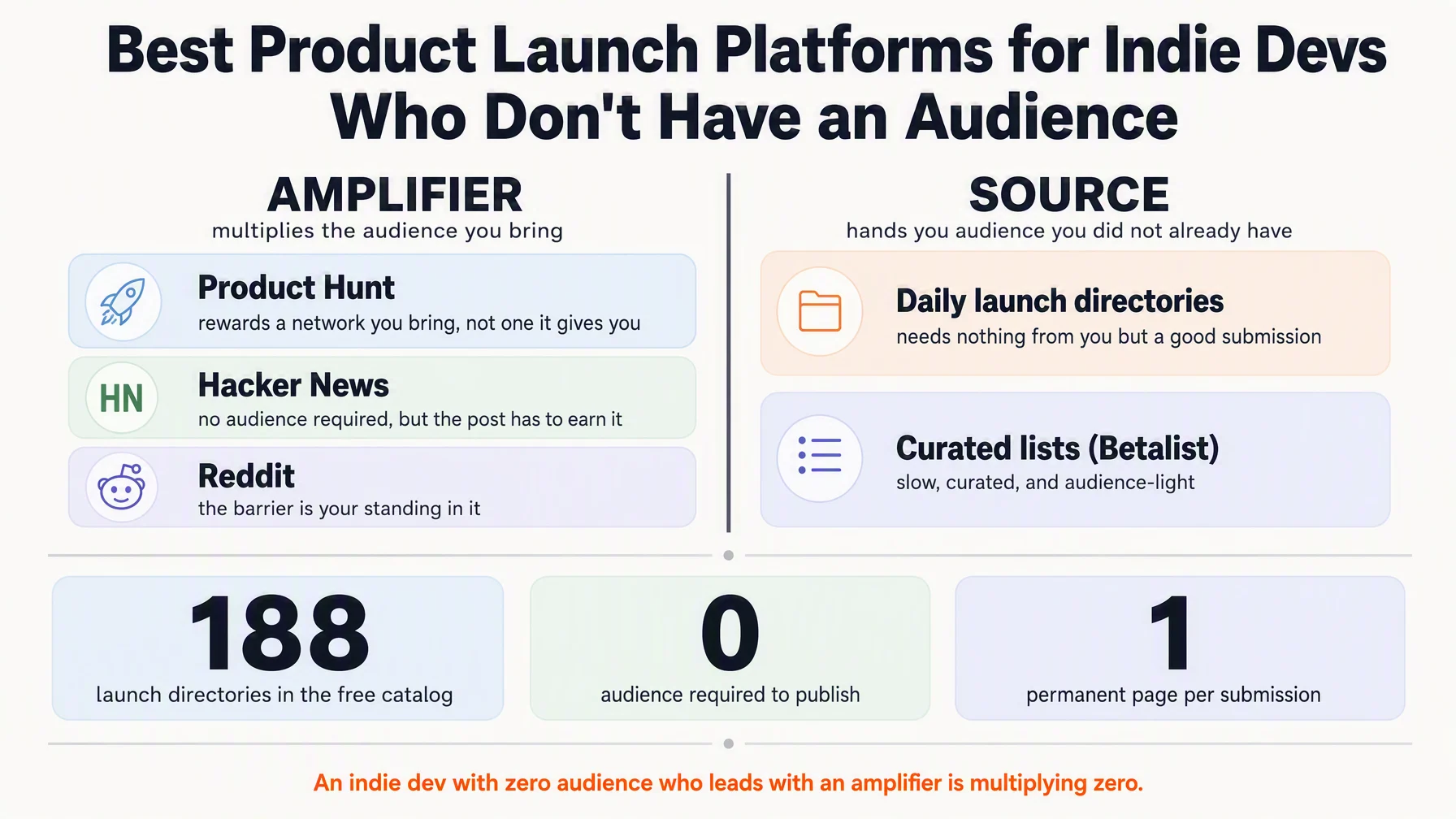
Split every launch venue into two categories. An amplifier multiplies the audience you bring. A source hands you audience you did not already have. Product Hunt, and to a real degree Hacker News and Reddit, are amplifiers: the outcome tracks the size and engagement of the crowd you can move toward the listing yourself. Directories, curated early-stage lists and niche communities are sources: they contribute reach that exists independently of whatever following you show up with.
An indie dev with zero audience who leads with an amplifier is multiplying zero. That is not a knock on the platform. Product Hunt does exactly what it is built to do, which is concentrate an existing crowd's attention on launch day. The mistake is expecting a multiplier to work when there is nothing on the other side to multiply.
Product Hunt: it rewards a network you bring, not one it gives you
Product Hunt's front page runs on votes, overwhelmingly from people the maker directly asked, not from browsing traffic discovering the listing cold. A serious launch there means lining up a hunter, preparing assets in advance, choosing a specific day, and spending that day actively messaging people to look and vote. Skip that prep and a listing typically sinks within a few hours, buried under ones that did the work.
None of that makes Product Hunt the wrong choice. With even a modest existing network, it remains one of the highest-ceiling single days available to an indie product, and a top placement can produce a real spike in signups and a badge worth keeping. The honest advice for someone with no audience is not to skip Product Hunt forever. It is to not lead with it, and not expect it to build the audience it actually requires you to already have.
Hacker News: no audience required, but the post has to earn it
Show HN and the general submission queue ask nothing about who you know. A single person with no followers can post and, if the product or the writeup is genuinely interesting to that specific readership, ride it to the front page purely on other users voting because they wanted to. That makes Hacker News the closest thing on this list to a pure meritocracy for someone starting from zero.
The tradeoff is variance. Whether a post catches on depends on the community's mood that day and a degree of luck that has nothing to do with how good the product is. A thread that does not take off in the first hour usually gets almost no visibility, and there is no consolation prize for trying. The cost of trying is close to zero, though, which is why it belongs early in a no-audience founder's list rather than last.
Reddit: the barrier is not the platform, it is your standing in it
Reddit's aggregate reach is enormous, but it is fragmented across thousands of subreddits, each with its own culture and its own patience for self-promotion. The platform itself does not require an audience. A specific subreddit does. Founders routinely underestimate this: they create an account, write a launch post, and submit it to a community they have never once commented in, and a moderator removes it within minutes, sometimes before a human reads it.
The fix is participating in the subreddit as a person before you post as a founder. Answer a few questions, comment on other people's projects, get a feel for what that community tolerates. Done that way, Reddit can outperform every other platform on this list for a niche product, because the audience is already self-selected around your exact problem. Done cold, it is the fastest way to burn an account and a launch post in one move.
Betalist and similar curated lists: slow, curated, and audience-light
Betalist and comparable curated early-stage lists sit in the middle of this spectrum. They require essentially no existing audience to get accepted, since acceptance depends on fitting the list's editorial bar rather than on votes. What they trade for that low barrier is speed and scale: submissions often queue for review, and the total reach on any listing is modest next to a strong Product Hunt day. For a genuinely early beta, though, the people who read these lists are there because they like trying new things, a better-matched audience than a general voting crowd, even at a fraction of the size.
Daily launch directories: the only category that needs nothing from you but a good submission
Directories built around a daily or weekly cadence, rather than a voting contest, are the one category here that asks nothing of your network at all. You submit, someone reviews it, and it publishes as a permanent page whether or not a single person votes for it. That page keeps working after launch week, staying indexed and linked long after a Product Hunt thread or a Reddit post has scrolled off anyone's feed, and it is the kind of stable, plainly described listing an AI assistant summarizing a category can retrieve later, too.
I maintain a free catalog of 188 launch directories, and the honest note from reading submissions through one of them is that this category is uneven in exactly the way you'd expect from something with a low barrier to entry: some listings stay crawlable and linked for years, others get pushed off the front of the site within weeks and effectively stop being found. Neither problem is really about audience. It is about picking directories that keep old listings live rather than burying them.
Reality check: none of these platforms is the single best one. A directory gives you a small, permanent thing. Hacker News gives you a shot at a large, temporary thing. Product Hunt gives you a large temporary thing only if you already have the network to make it large. The right combination matters more than a winner.
What an audience-less indie dev should actually do first
Start with the venues that need nothing from you but a good submission and some patience. Submit to a handful of daily directories and one or two curated lists like Betalist, since neither depends on anyone you know clicking a link, and both leave you with something permanent. Alongside that, if the product or the story behind it is genuinely interesting, write up a Show HN post and try it, since the cost is a few minutes and the upside, while unpredictable, requires no followers. Spend real time in one or two relevant subreddits before you ever post there, contributing as a person first so a launch post from you reads as coming from someone the community recognizes, not a stranger with a link. Save Product Hunt for later, once you have built even a small amount of the audience it needs, whether that is a short list of early users, people from those other launches, or a newsletter with a few hundred names on it. Launching there before that audience exists spends a good idea on a day that was never going to go anywhere.
Written by Nick Launches, a daily launch directory where every listing is a permanent page with a do-follow link and a source of discovery traffic.