A few years ago, I watched a small software company publish an article around a topic that almost nobody was searching for.
The keyword tools hated it.
Search volume was close to zero. There were no impressive traffic estimates, no obvious clusters to build, and no competitors fighting over the phrase. By every conventional SEO metric, it looked like a waste of time.
Six months later, the market changed.
A handful of products in that category started growing. People began discussing them on Reddit and X. Comparison searches appeared. Then came the predictable wave:
“best tools for…”
“X alternatives”
“X vs Y”
“how to use X”
By the time the keyword appeared inside traditional SEO tools with meaningful volume, the company that had published early was already sitting near the top of the results.
That experience changed the way I think about SEO.
Most SEO systems are designed to tell you what people searched for yesterday.
The bigger opportunity is figuring out what they will search for tomorrow.
Search volume is a lagging indicator
Keyword research is useful. The mistake is treating it as a map of the future.
Most keyword databases work by observing existing behavior. A query has to become common enough to be measured before it becomes interesting in the dashboard.
That creates an unavoidable delay.
Imagine a new AI workflow suddenly becoming popular.
The sequence often looks something like this:
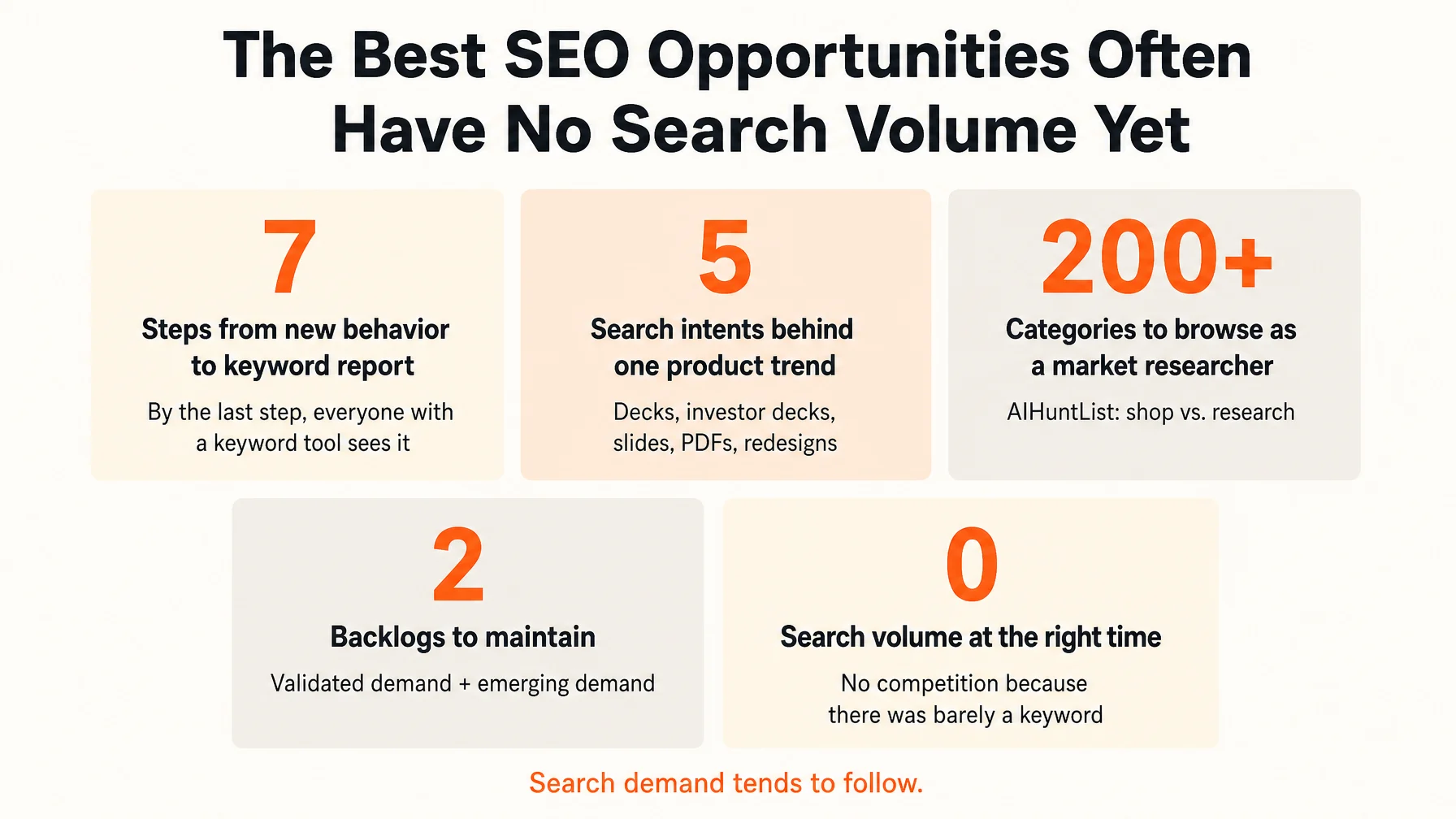
A new behavior emerges → products appear → early adopters start using them → communities discuss them → people compare solutions → searches increase → SEO tools report the keyword
By the time the final step happens, the opportunity is no longer undiscovered.
Everyone using the same keyword database can see it.
The irony is that modern SEO software has become extremely good at helping thousands of marketers discover the exact same opportunities.
A keyword with:
- 8,000 monthly searches
- low difficulty
- strong commercial intent
looks wonderful.
It also looks wonderful to every competitor with an Ahrefs or Semrush subscription.
So the real edge increasingly comes from looking outside the keyword database.
The new job of SEO is demand sensing
I think a useful distinction is emerging between two types of SEO research.
The first is demand measurement.
You look at:
- search volume
- keyword difficulty
- CPC
- SERP competitors
- existing traffic
This tells you where demand already exists.
The second is demand sensing.
Instead of asking “What are people searching for?”, you ask:
What are people starting to care about?
That sends you toward completely different datasets.
You start watching:
- new products entering a category
- rapidly growing tools
- recurring questions in communities
- new terminology
- funding and product launches
- emerging workflows
- changes in how people describe a problem
This is particularly powerful in fast-moving markets such as AI.
A new AI category can go from obscure to crowded in months. Waiting until “best AI agent for X” has obvious search volume often means waiting until dozens of sites have already published the same article.
The better time to write it was when five interesting products had just appeared and nobody knew what to call the category yet.
Directories are becoming an underrated SEO research tool
This is one reason I think product directories are more interesting for SEO than they first appear.
Most people use a directory because they want to find a tool.
An SEO researcher can use the exact same database differently.
Take AIHuntList, for example. It organizes thousands of AI products across more than 200 categories, including writing, image generation, video, coding, productivity, SEO, and increasingly narrow AI use cases.
Instead of browsing it as a shopper, browse it as a market researcher.
Look for categories where:
- six months ago there were two products and now there are twenty
- several companies suddenly describe themselves using the same phrase
- a broad category is splitting into smaller specialist categories
- multiple products solve the same strangely specific problem
Those are often early signs of future search demand.
If ten founders independently decide that “AI video repurposing” or “AI browser agents” deserves a standalone product, there is a good chance users will eventually need language for discovering, comparing, and evaluating those products.
Search demand tends to follow.
Traffic growth tells you something keyword volume cannot
Product count gives you one signal.
Actual adoption gives you another.
This is where I find traffic-based product datasets particularly useful.
AITrustList takes a somewhat different approach to AI product discovery: alongside its directory, it ranks products using traffic and engagement signals rather than treating every listing as equally important.
For SEO research, that changes the question.
Instead of:
“Which AI tools exist?”
you can start asking:
“Which types of AI tools are suddenly attracting users?”
Its Fastest Growing AI Tools ranking is especially interesting for this purpose because it focuses on month-over-month momentum rather than simply rewarding the largest products.
A huge incumbent growing 2% may matter less to an opportunity researcher than a previously obscure product growing 80%.
That doesn't automatically mean you should write about it.
It means something changed.
And “something changed” is often where good SEO research begins.
Follow the product, then find the keyword
This reverses the normal keyword research process.
Traditional SEO often works like this:
Find keyword → inspect SERP → create content
I increasingly prefer:
Notice change → understand why → identify future queries → create content
Suppose you notice three AI presentation products growing unusually quickly.
Don't immediately write “Best AI Presentation Tools.”
Investigate the underlying behavior.
Why are people adopting them?
Perhaps users are not really searching for “AI presentation tools.” They are trying to:
turn documents into decks
create investor presentations
convert research into slides
generate presentations from PDFs
redesign ugly PowerPoints
Suddenly you have five search intents instead of one generic category keyword.
Some may already have volume.
Others may barely exist yet.
The latter can be the most interesting.
Write the page before the category has a name
Some of the highest-leverage SEO pages begin life looking slightly strange.
There isn't a perfectly established keyword.
The terminology is inconsistent.
Competitors describe the same concept differently.
That is precisely why the opportunity exists.
Google eventually has to decide which pages explain a new concept well.
If your page was created after everyone agreed on the terminology, you are competing with an established SERP.
If your page helped explain the terminology in the first place, you have a very different starting position.
This doesn't mean inventing meaningless buzzwords and creating hundreds of pages around them.
It means recognizing when user behavior is real before keyword tooling has caught up.
There is a difference.
Build an “emerging demand” list
One practical way to use this idea is to maintain a second keyword backlog.
Keep your normal SEO backlog:
Validated demand
These are topics with recognizable volume, commercial intent, and known competitors.
Then create another one:
Emerging demand
A topic goes into this list when you see evidence such as:
- several new products entering the same niche;
- one or more products showing unusual traffic growth;
- repeated discussion of the same problem in communities;
- new phrases appearing across product descriptions;
existing categories splitting into narrower use cases.
You don't need to publish everything.
Monitor the signals.
When two or three begin reinforcing each other, move early.
This turns SEO research from a static quarterly exercise into something closer to market intelligence.
This matters even more because of AI search
There is another reason early authority matters now.
Search no longer means only ten blue links.
Users increasingly ask ChatGPT, Perplexity, Gemini, Claude, and other answer engines to recommend software, explain categories, and compare products.
These systems often need sources that clearly define:
- what a category is
- which products belong to it
- how the products differ
- what users should consider when choosing one
That creates a strange new opportunity.
The page that explains a market clearly may matter even before the market produces enormous Google search volume.
In other words, SEO and GEO are beginning to reward something that content marketers should have cared about all along:
understanding a market earlier and explaining it better.
Stop asking only what has traffic
There is nothing wrong with chasing existing search volume.
If a commercially valuable keyword is sending thousands of visitors to competitors, you should probably compete for it.
But if that is your entire SEO strategy, you are permanently looking backward.
Every keyword chart is a historical document.
It tells you that demand became measurable.
It doesn't tell you where demand is being created.
For that, you have to watch users, products, categories, communities, and adoption.
The best SEO opportunity I mentioned at the beginning didn't look attractive when it was published.
That was the point.
There was no competition because there was barely a keyword.
By the time everyone else could see the opportunity in their SEO dashboard, the advantage had already been created.
Maybe that is the more useful way to think about modern SEO:
Don't just rank for what people search today.
Learn to recognize what they are going to need a name for tomorrow.
Guest post by Shawn (@ShawnHacks), creator of AITrustList and AIHuntList.
Shawn builds AITrustList, an AI tools directory that ranks products by traffic and engagement signals, and AIHuntList, a directory of thousands of AI products across more than 200 categories.