Using AI to Speed Up Content Research for SEO
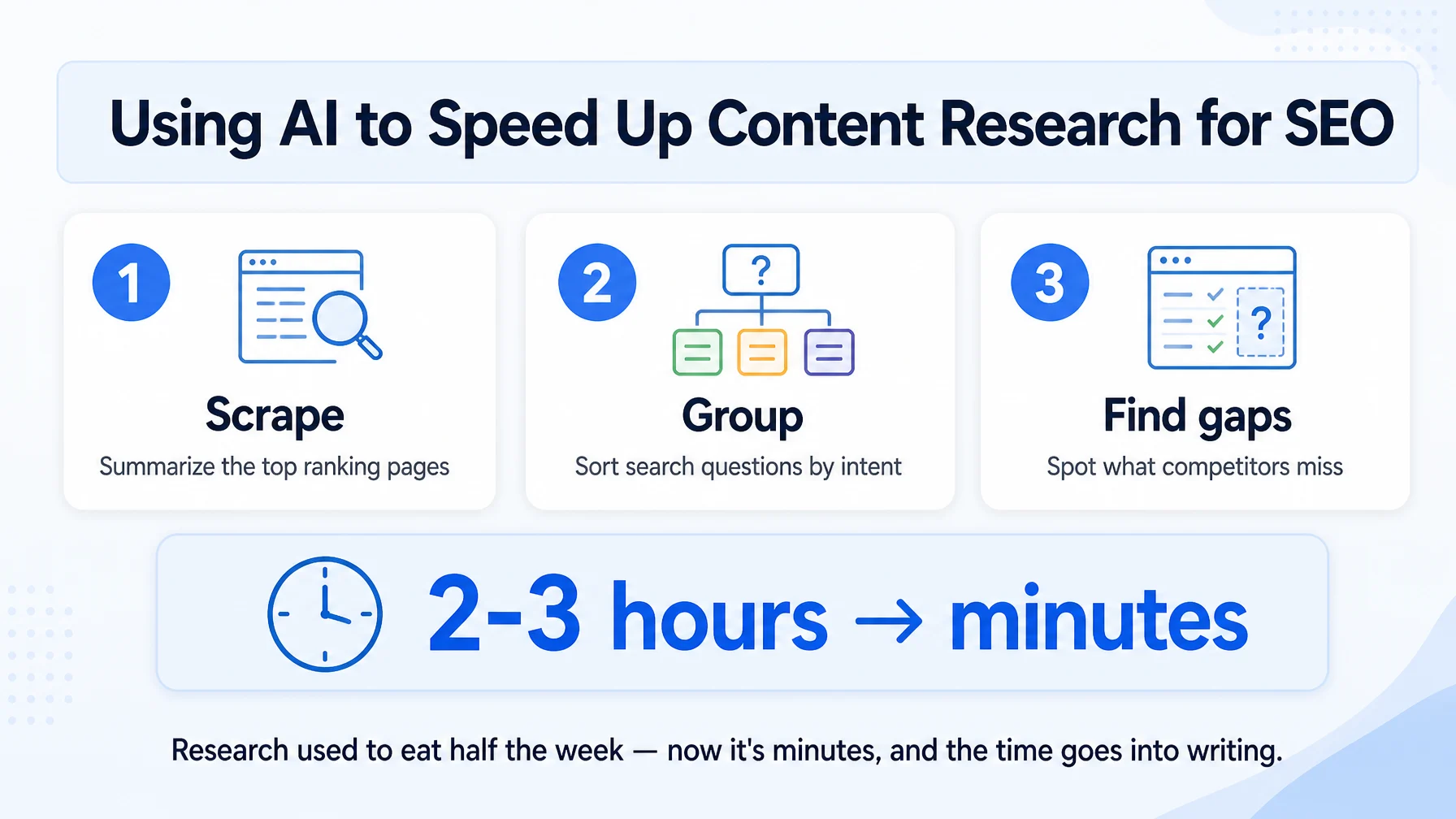
Previously, content research involved switching between multiple tabs of search results, old notes, and competitor pages, taking hours. It may take a whole morning for a writer to determine what a blog post is going to cover. That has changed. In just a few minutes, AI software can now search hundreds of pages, identify patterns, and summarize what is already ranking. It's not a substitute for a writer's judgment. It gets rid of the slow part: the searching, the reading, the sorting. That saved time really adds up for SEO teams managing multiple clients at the same time. Research used to eat up half the week for any digital marketing agency Fort Lauderdale businesses. Now, it takes a bit of that and the additional time is spent on writing. Let's look at how AI accelerates the process and where human intervention is still needed.
Why Did It Once Take So Long to Do Research?
Pre-AI research was about having to open 10-20 tabs and read from beginning to end of each page. It was up to you to figure out which competitor articles to read. You would have to jot down what you saw in another document and then go back to the document and see whether you had done the right thing before writing.
Not a single bit of effort went into it wastefully. However, it was slow and it distracted people from the real writing. It can take 2-3 hours to map out one topic. If you multiply that by a content calendar that has 10 posts per month, you'll find that research takes up a massive amount of your schedule.
Either research was sacrificed or productivity was lagging. The two did not result in any improvement of rankings. Thinner articles that omitted key subtopics were the result of taking shortcuts. If you get behind, less content is put out, which is going to reduce the speed of the site's authority building in a niche. Whichever the case, the problem was almost never the writing per se. It was all the elements that had to come together before the first sentence could fall.
In the Research Phase, AI Can Handle a Significant Amount of the Work
AI tools can improve reading speed compared to any person in the world. Feed one a topic, and it will return the highest ranked pages, list the main headings found on those pages, and highlight the things that appear repeatedly on the highest ranking pages. That will help you create a shape for your article before you write the first sentence.
It can also categorize related keywords by intent, so you can see which are looking for an answer and which for a step-by-step guide. And it can transform a cluttered stack of notes into an outline in a matter of seconds. There's no magic here. It's pattern matching at speeds which no human can beat.
This frees up the bigger change. If the outline and the grouping of the keywords are prepared in advance before you open a blank document, you'll begin writing with a map, rather than a blank page and a general idea. Just that helps to save some time when drafting since you're not sitting and checking something every few paragraphs.
Identifying Topics and Gaps in Less Time
One of the best applications of AI in research is to identify opportunities that are not being pursued by competitors. You can request a tool to evaluate the top five or six pages for a topic and provide a list of the content for each page. Whatever is missing in all of them is very likely your starting point.
This is suitable for:
- Identifying subtopics that are mentioned but not well explained by competitors
- Identifying stale information found on ranking pages
- Grabbing questions appearing in search tips and not in any article
A writer might identify these gaps on his own, but that would be much longer and he may miss a valuable item that's on the second page of a competitor's blog. AI won't get bored after the 3rd or 4th page, so it will find the little things that a human may overlook.
Reading and Summarizing Competitor Content in Just Minutes
Rather than reading the entire article yourself, you can just paste the text into an AI tool and request a summary of the main ideas, organization, and tone. This helps you get a quick overview of the content that already exists and doesn't waste an hour reading it.
This is most important when there is extensive coverage of a topic. Instead of reading the 10 articles yourself, you can get a feel for the 10 articles in the time it took you to read one article. You are still reading the things that are important to you, but you are doing so based upon the actual signal, and not what you think it is.
Recognizing Questions Real People Are Asking
The search engines already present suggestions of what people are searching for, such as autocomplete, related searches, and the question box. These signals can be gathered by AI tools and then categorized by theme, which eliminates the need to scroll through search pages.
This enables you to create content that responds to the question being asked, rather than some version of the question that you think people were asking. It also gives you an idea of which questions should be included in a different paragraph and which ones should be placed into a single paragraph.
Checking Facts Before They Reach a Draft
If the research doesn't hold up, then speeding does not help. There is a risk that the information in AI models may be inaccurate, particularly when it involves numbers, dates or information sourced from a specific location. Don't take anything an AI tool gives you for granted as a fact.
Verify any content against a primary source before it goes into a publication. This takes only a couple of minutes and it's a way to keep your credibility intact. Skipping this step is how errors end up on a live page, and errors are far more costly to correct after the fact than before, especially after a page has been indexed and gotten links or shares based on an incorrect number.
The general guideline applies: if the fact might make you or a client look bad if it was wrong, make sure to check it before it enters any draft.
Where AI Still Falls Short
AI is quick, but it is unaware of your client, your audience and your brand voice if you don't tell it. It can't determine if the competitor's claim is true or not. It usually levels out the little, specific things that give your content that "done by someone" quality.
It also has no formal training in any specific industry, either, like a specialist. It has heard of many things but has never experienced them. This is where a human researcher and writer still finds their place. Collect and categorize with AI. Determine what is important using judgment.
Turning Scattered Notes Into a Real Structure
Research is only useful if it becomes something that you can write about. After the research, a lot of teams waste time at this step. The end result is a folder of links, some screenshots, and a half-done document with little to no content.
AI can take that same random mess and create a working outline, complete with headings, a rough order, and notes under each section about what to cover. You still have to write it in your own words and put in your own perspective, but you don't have to do it from scratch. Most of the time saved is in the difference between a blank page and a rough map.
Creating a Simple Research Workflow
To save time, a workflow doesn't have to be complicated. The following is a helpful configuration:
- Get AI to scrape the top 5 ranking pages for your topic
- Have it list common subtopics and any gaps between them
- Scrape the top questions from search results and categorize them
- Summarize any long competitor articles that you still need to reference
- Verify information or numbers against a real source before taking them for granted
The individual steps will each only take a few minutes. Combined, they can take the place of an old-fashioned afternoon of rummaging.
Starting Small and Keeping Things Simple
You don't need a lot of tools or a lot of money. Most content teams will need one general AI assistant and a critical eye to verify that the work is accurate and based on real sources. Include an additional SEO tool later if a large amount of work is required.
The aim is to not fully hand over the research to AI. Its purpose is to eliminate the dull, tedious aspects of the job so the writer can focus on what he or she should say and say it effectively.
Start small. Now choose your next topic, repeat one or two of the steps above, and experience the time savings. Most teams will know the answer after the first try, and then it becomes business as usual in the content production process.