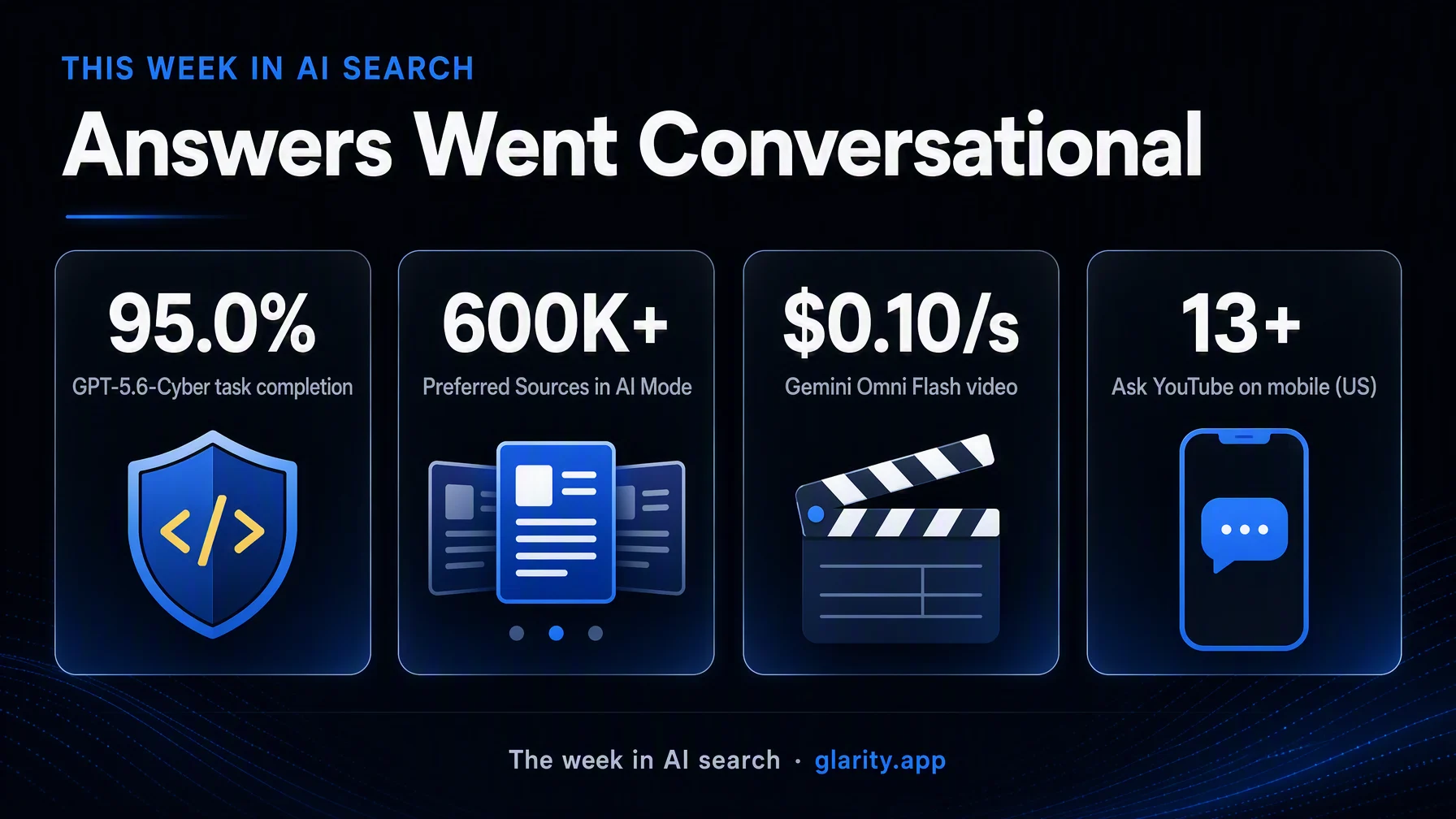
Conversational search consolidated its place this week: YouTube's Ask feature expanded to mobile across the US, Google added developing-topic link carousels to AI Mode, Gemini Omni Flash opened to developers as a video-editing model, OpenAI shipped GPT-5.6-Cyber alongside new Daybreak access tiers, and ChatGPT ads launched across 30-plus European countries. Below are the stories worth your time — each with one line on why it matters — plus what we published this week on Glarity.
YouTube's Ask search reaches phones
YouTube's Ask YouTube conversational search — where you type a natural-language question and get a chat-style answer built from long-form videos, Shorts, and web results — expanded to mobile in the US this week, per reports from The Verge and Android Authority. The feature now covers signed-in US viewers aged 13+ (it was previously a Premium, 18+ experiment), with answers that jump straight to the most relevant timestamp in a video and support follow-up questions in the same conversation. Google's official help page adds useful context: the feature is explicitly experimental, comes with the usual generative AI caveats, and conversations tied to a Google Account are deleted automatically after 45 days.
Why it matters: this is YouTube repositioning search itself around AI answers. But Ask is a discovery layer, not a digestion layer — it points at a moment in a video rather than giving you a clean transcript or chapter-by-chapter notes. That gap is exactly what we built a tutorial for this week: how to translate any YouTube video with side-by-side subtitles.
AI Mode starts ranking the news
On August 25, Google's VP of Product for Search, Robby Stein, announced that developing-topic link carousels are now live in AI Mode — a horizontal strip of article cards (image, headline, source, date) shown inside the AI response for queries about evolving topics, after the format had already landed in AI Overviews. Google also noted that more than 600,000 unique sources have been saved as Preferred Sources, up from 345,000 in May, and that a site's Preferred Sources can be surfaced inside these carousels. The details come from Search Engine Journal's coverage of the announcement.
Why it matters: when an AI answer can rank the news directly, being cited inside it becomes the new headline slot — and the Preferred Sources count shows how quickly webmasters have adapted to that reality.
Gemini Omni Flash: video editing goes conversational
Google made Gemini Omni Flash available to developers for the first time — an official announcement covering the model and its companion, the rapid image model Nano Banana 2 Lite. Gemini Omni Flash generates and edits videos conversationally: you refine a clip with natural language, reference images, or other video, with editing done over the new Interactions API (up to three sequential edits). The numbers worth knowing:
- $0.10 per second of generated video
- 3–10 second outputs at 720p, 24 FPS, with longer holds coming
- 1,048,576-token context window — the whole conversation can ride along
- Outputs carry SynthID watermarking, and Google ships three demo apps chaining Nano Banana 2 Lite stills into Omni Flash motion
Why it matters: the same conversational pattern now applies to images and video, not just text — and $0.10/second puts it at the same price point as Veo 3.1 Fast.
OpenAI's cyber model and its $67B quarter
OpenAI expanded its Daybreak cybersecurity program into two access tiers: Daybreak Blue (defensive work with GPT-5.6 Sol, guards removed) and Daybreak Red (authorized offensive work with the new GPT-5.6-Cyber). On OpenAI's own Advanced Cybersecurity Completion Rate evaluation, GPT-5.6-Cyber completed 95.0% of tasks versus 1.5% for GPT-5.6 Sol, 2.0% for the Daybreak Blue variant, and 57.3% for the previous GPT-5.5-Cyber — a model aimed at authorized vulnerability research, exploit validation, and penetration testing, with vetted-partner access only.
Separately, ChatGPT ads began appearing in Denmark and 30 other European countries on August 24, following the US and earlier markets — clearly labeled and separated from answers, with advertisers getting no access to user conversations, as reported by Computerworld. And on the API side, OpenAI cut developer pricing on GPT-5.6 Sol by more than 20% for three months, first reported August 21 by CCTV Finance; the current rates are on OpenAI's pricing docs.
Claude Opus 5: root cause found
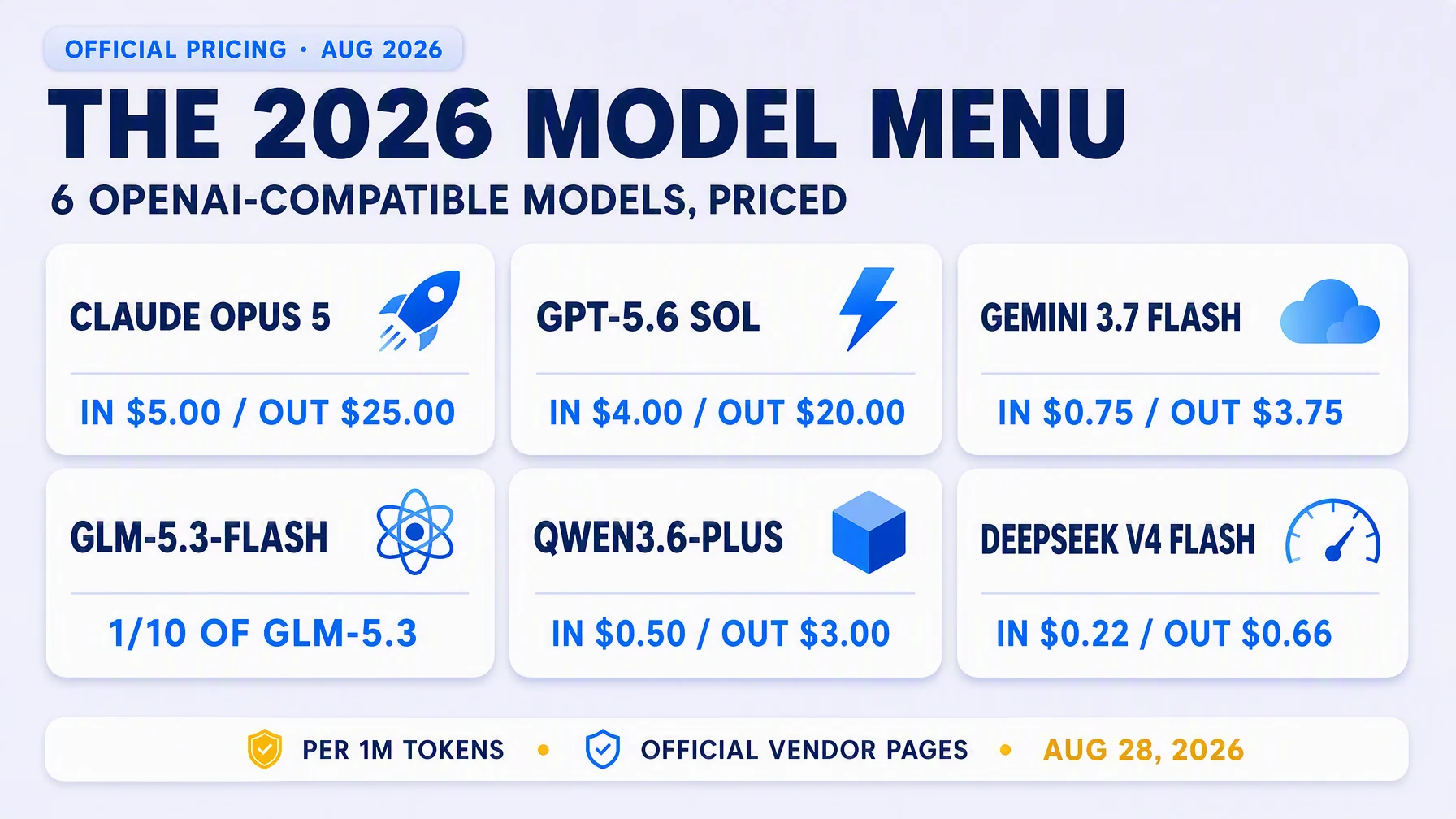
Anthropic's release notes now document that the elevated error rates affecting Claude Opus 5, Mythos 5, and Fable 5 have been root-caused and are being fixed — a status update on Anthropic's release notes page this week. It's a small transparency win, but worth tracking if you rely on Anthropic family models in your workflows, because Opus 5 sits at $5/$25 per million tokens and is positioned as "half the price of the frontier."
The summarizer landscape shifted
Two ecosystem moves this week:
- Summarize.tech went dark — as of August 6 it returns a 503 served with the message "DEPLOYMENT_PAUSED". No migration was announced. When a widely recommended tool disappears, it's a reminder that your summarization workflow should not depend on a single third-party service.
- A new free player in Japan — up: Satellite Office, a Tokyo company, started offering a free "YouTube Summary" feature on August 26 (reported by Excite News): automatic transcription, three summary styles (standard, PowerPoint-ready, report-ready), AI Q&A about the video, comment analysis, and automatic related-URL extraction, with PPT auto-generation and mind maps on the roadmap. The multilingual market is getting more crowded, and free tiers are part of the draw.
For Glarity users, the practical answer stays the same: a browser extension with your own model choice means you're never locked into a service that can pause overnight.
What we published this week
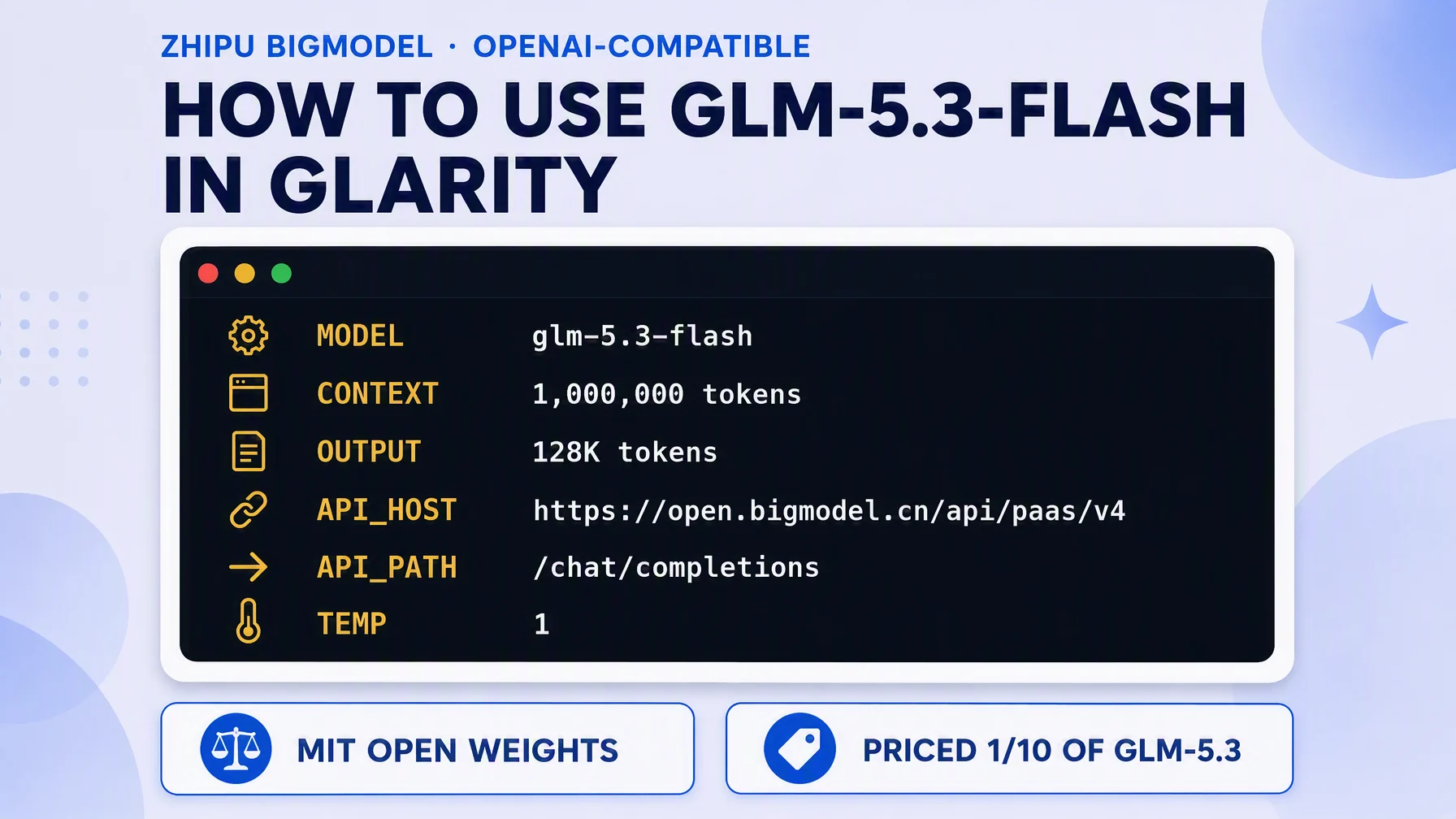
We spent the week on models you can bring to Glarity yourself. The full series is live in five languages — including How to Use Gemini 3.7 Flash in Glarity (1,048,576-token context, promo pricing through the end of 2026) and the Monday tutorial on translating YouTube videos with dual subtitles.
What we're watching next
Three threads for next week: whether YouTube follows the Ask mobile rollout with non-English markets (Glarity's own localizations follow the same path), whether AI Mode carousels make "cited in AI Mode" the new SEO KPI, and whether any of the Gemini Omni Flash conversation editors ship a consumer version that can genuinely summarize long videos.
FAQ
What is the biggest AI search news this week? Video search went conversational: YouTube's Ask expanded to mobile in the US for signed-in 13+ users, and Google's AI Mode picked up developing-topic link carousels inside AI answers.
Is Ask YouTube free? Yes — it's an experimental feature in the YouTube app and on desktop, currently for English searches by signed-in US users aged 13+. Note that Google's help page marks it as experimental with standard generative AI caveats.
What did Gemini Omni Flash launch? It's Google's video-generation and editing model, now in public preview for developers at $0.10 per second of output, with conversational multi-turn editing, 3–10 second clips at 720p, and SynthID watermarking.
Which models did OpenAI release this week? GPT-5.6-Cyber, a purpose-trained cybersecurity model for Daybreak Red access (95% vs 1.5–2% completion on advanced cybersecurity tasks), alongside a developer price cut on GPT-5.6 Sol and the expanded Europe rollout of ChatGPT ads.
Why should I care that Summarize.tech shut down? Because single-vendor summarization services come with single-vendor risk. Keeping your transcript, summary, and translation steps in an extension with your own model choice keeps the workflow portable.
By the Glarity Editorial Team. The Glarity Editorial Team writes about AI search, video summarization, and getting more from your browser.